Queer Places:
University of Michigan, 1230 Murfin Ave, Ann Arbor, MI 48109
Wellesley College (Seven Sisters), 106 Central St, Wellesley, MA 02481
Brady Hill Cemetery, 400 E Holland Ave, Saginaw, MI 48601, United States
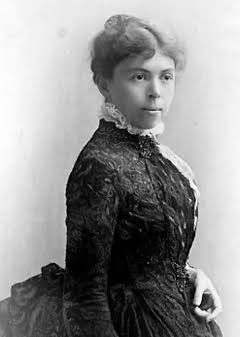 Alice Freeman Palmer (born Alice Elvira Freeman, February 21, 1855 - December 6, 1902) was a pioneering American educator and a transformative figure in women's higher
education. Raised in a modest farming family, she showed an exceptional intellect from a young age. Despite financial challenges and societal barriers discouraging higher
education for women, she attended University of Michigan, graduating in 1876. She faced initial skepticism due to her gender, but ultimately earned the respect of the
faculty through her academic brilliance, later completing graduate studies and establishing herself as a formidable intellectual and administrator.
Alice Freeman Palmer (born Alice Elvira Freeman, February 21, 1855 - December 6, 1902) was a pioneering American educator and a transformative figure in women's higher
education. Raised in a modest farming family, she showed an exceptional intellect from a young age. Despite financial challenges and societal barriers discouraging higher
education for women, she attended University of Michigan, graduating in 1876. She faced initial skepticism due to her gender, but ultimately earned the respect of the
faculty through her academic brilliance, later completing graduate studies and establishing herself as a formidable intellectual and administrator.
In 1879, Freeman was appointed professor of history at Wellesley College, a newly established institution dedicated to providing women with an education equivalent to
that of elite men's universities. Just three years later, in 1882, at the remarkably young age of 27, she was named President of Wellesley College.
As president, Freeman expanded the academic rigor of the college, elevated its national reputation, and recruited a brilliant, highly dedicated faculty. However, the
relentless demands of leadership exacted a heavy personal and physical toll, leaving her chronically exhausted and overwhelmed by the immense responsibilities of managing a
pioneering institution.
During her time at Wellesley, Freeman's life intersected with complex personal and romantic dynamics typical of the era's academic women's networks:
Carla Wenckebach, a prominent professor in Wellesley’s German department who practiced a form of nineteenth-century gender
inversion and rejected men as romantic objects, fell deeply in love with Freeman. Wenckebach viewed Freeman as the center of her world.
When Freeman eventually accepted a courtship, Wenckebach experienced profound grief, reportedly attending the wedding "as if to a funeral" and remaining irreconcilably
heartbroken. Wenckebach later formed a lifelong domestic partnership (or "Boston marriage") with her colleague
Margarethe Muller, which lasted until Wenckebach's death.
In 1886, George Herbert Palmer, a Harvard philosophy professor, began courting Alice Freeman. Recognizing her profound exhaustion from the stresses of the presidency,
Palmer offered her a refuge that contrasted sharply with her demanding public role. He invited her to step away from her "masculine" burdens of institutional power and
return to traditional Victorian gender dynamics, writing to her: "Will you not become a girl again and come like a child to our Class Day?"
For Freeman, who felt the crushing weight of leadership and remained deeply influenced by nineteenth-century ideals of womanhood, the temptation to abdicate
administrative power was irresistible. She wrote back with pathos: "Perhaps if this ‘becoming a girl again’ should succeed, it would be just as effective as a longer
vacation."
The couple married in 1887. Upon her marriage, Alice Freeman resigned from the presidency of Wellesley College, though she maintained an influential role as a college
trustee.
After leaving the Wellesley presidency, Alice Freeman Palmer remained a towering figure in American education and public life:
She served as the first Dean of Women at the University of Chicago from 1892 to 1895, appointed by President William Rainey Harper, helping shape the coeducational
environment of the young institution.
She was deeply involved in educational reform, writing, lecturing, and serving as a founding member and president of the Association of Collegiate Alumnae (which later
became the American Association of University Women, or AAUW). She also served on the Massachusetts State Board of Education.
Her inner emotional life and the philosophical reconciliation of her public achievements with traditional womanhood were captured in her poetry, published posthumously by
her husband in 1915 as A Marriage Cycle. The collection reflects her relief in laying down the heavy burden of institutional power to embrace domestic partnership, as
summarized in her poem "Attainment":
> Great love has triumphed. At a crisis hour
> Of strength and struggle on the heights of life
> He came, and bidding me abandon power,
> Called me to take the quiet name of wife.
Alice Freeman Palmer died unexpectedly on December 6, 1902, in Paris, France, following complications from surgery. Her legacy endured through the Alice Freeman Palmer
Memorial at Wellesley College and her foundational impact on opening doors of higher education for generations of American women.
References:
Other References:
- Margarethe Muller, Carla Wenckebach, Pioneer (Boston: Ginn & Company, 1908)
- George Herbert Palmer, The Life of Alice Freeman Palmer (Houghton Mifflin Company, 1908)
- Alice Freeman Palmer, A Marriage Cycle (Houghton Mifflin Company, 1915)
- Academic and Cultural History Scholarship – Modern historical analyses examining turn-of-the-century women's education, "Boston marriages," academic networks, and gender roles at institutions like Wellesley College.
Support this project
This website is a passion project researched, developed, and funded entirely by me. If you find the content valuable and would like to help support the ongoing research and hosting costs, any contribution is deeply appreciated.
Thank you for keeping this independent resource alive!
My books on Amazon: Elisa Rolle's books
BACK TO HOME PAGE
